Short answer
No. A water resistant phone passed a lab test in still, fresh water at a set depth and time when it was new. That is not waterproof. Salt, chlorine, steam, pressure and age all fall outside the test.
The box says IP68. The advert showed someone filming under water. Then the small print says not to take it swimming, and the warranty says liquid damage is not covered.
All three statements come from the same company, which is what makes this confusing. The rating is real, and it means less than the advert suggested. Regulators in two countries have said so, with fines attached.
Is Any Phone Actually Waterproof?
No mainstream phone is. Waterproof would mean water cannot get in under any conditions for as long as the phone lasts, and no maker claims that in writing.
Water resistant is a smaller promise, which is that the phone kept water out during one specific test. Seals, gaskets and adhesive strips do the work, and they are consumable parts.
Google states it most bluntly, telling Pixel owners that the phones are designed to be water resistant and then not to submerge the phone at all.
How to Read an IP Rating
IP stands for ingress protection, and the code comes from an international standard, IEC 60529. The first digit rates protection against dust and solids, and the second rates protection against water.
| Code | What the water digit means |
|---|---|
| IPX4 | Splashes from any direction |
| IP67 | Immersion to 1 metre for 30 minutes |
| IP68 | Immersion deeper than 1 metre, on terms the maker sets |
| IP69 | High-pressure, high-temperature water jets |
| IPX8 | Same water test as IP68, with no dust rating |
A 6 in the first position means dust-tight. An X means that part was not tested, which is why folding phones often carry IPX8.
Two details get lost in the marketing. A higher number is a different test and not always a harder one, so IP69 does not include the immersion test of IP68. The 8 also has no fixed depth, because the maker chooses it.
What Was a Water Resistant Phone Tested For?
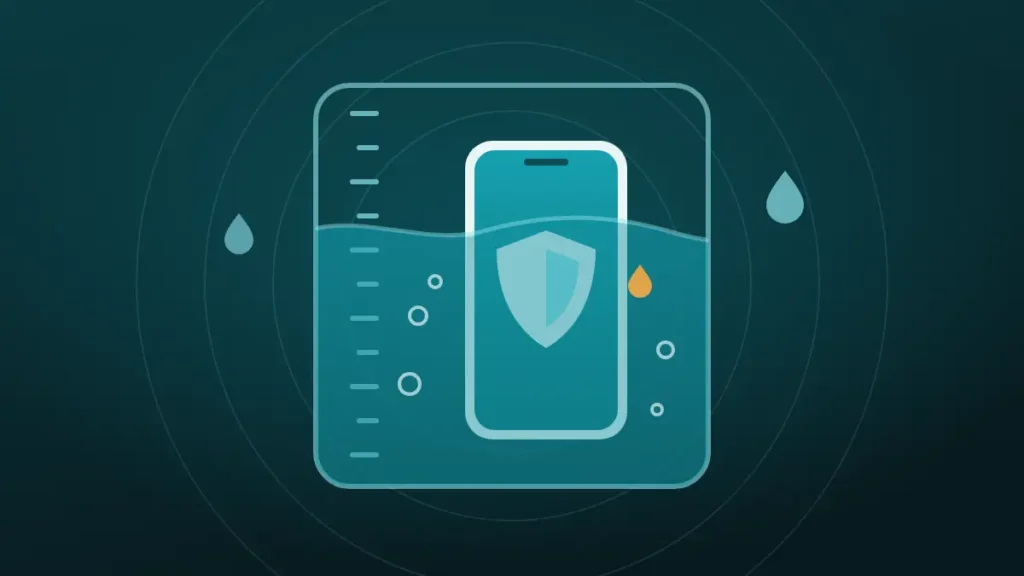
The test is narrower than most owners assume. A new phone, straight from the production line, is lowered into a tank and left there.
- The water is fresh, with nothing dissolved in it.
- The water is still, with no waves, jets or movement.
- The depth and time are fixed in advance.
- The phone is new, undropped and unrepaired.
Apple describes its ratings as tested under controlled laboratory conditions. Samsung’s footnote is more specific, and worth reading in full. It says the rating is based on lab tests in fresh water, that the phone is not advised for beach or pool use, and that the resistance is not permanent.
So the rating answers one question, which is whether a new phone survived a calm bath of clean water. It was never asked about anything else.
IP68 Means a Different Depth on Every Brand
Because the maker sets the terms of the 8, two IP68 phones can differ by a factor of four.
| Phone | Rating | Stated depth and time |
|---|---|---|
| iPhone 12 and later | IP68 | 6 metres for 30 minutes |
| iPhone 11 Pro and 11 Pro Max | IP68 | 4 metres for 30 minutes |
| iPhone 11, XS and XS Max | IP68 | 2 metres for 30 minutes |
| iPhone 7 to XR, and SE | IP67 | 1 metre for 30 minutes |
| Recent Samsung Galaxy S series | IP68 | 1.5 metres for 30 minutes |
| Samsung Galaxy Z foldables | IPX8 | 1.5 metres for 30 minutes |
The figures are the makers’ own, and they describe the test, not a recommended use. Thirty minutes at six metres in a tank says little about thirty seconds in the surf.
What Does the Lab Test Leave Out?
Nearly everything that happens to a phone outside a laboratory.
| Real-world condition | Why the rating does not cover it |
|---|---|
| Sea water | Salt corrodes contacts and stays behind as crystals |
| Pool water | Chlorine and chemicals were not in the test tank |
| Soap, shampoo and sunscreen | Can weaken seals and help water creep past them |
| Hot water and steam | Vapour passes where liquid cannot, and heat softens adhesive |
| Jets, waves and dives | Moving water presses far harder than still water at the same depth |
| Age, drops and repairs | Seals wear, shift and get disturbed |
Steam is the one that surprises people. A phone on the bathroom shelf during a hot shower is never submerged, yet vapour can work its way in and condense inside.
Pressure is the other. Jumping into a pool with a phone in a pocket hits the seals with a sudden force that a slow lowering into a tank never produces. What salt and chlorine do afterwards is covered in why salt water and pool water are worse than rain.
Regulators Have Fined Phone Makers Over Waterproof Ads
The gap between the advert and the small print has been tested in court, and the phone makers lost.
In 2022, Australia’s Federal Court ordered Samsung Australia to pay a penalty of 14 million Australian dollars. Nine adverts had shown Galaxy phones in pools and the sea. Samsung admitted that if those phones were charged while still wet from pool or sea water, the charging port could corrode and stop working.
Two years earlier, Italy’s competition authority fined Apple 10 million euros. It found the advertised depths held only in controlled tests with static, pure water. It also objected to Apple refusing warranty service for the liquid damage its adverts made light of.
Neither ruling said the phones were badly made, only that the marketing promised more than the test proved.
Why Does a Rated Phone Still Leak?
Because water resistance is a condition, and conditions change. A phone is held shut by adhesive around the screen and back, with small gaskets at the SIM tray, buttons and ports.
Those materials age. Heat from charging and sunshine softens the adhesive and lets it creep, and a drop can open a gap too small to see. Pocket lint, sand and dried soap can sit on a gasket and hold it open.
Apple says so directly on its water-resistance page, which states that splash and water resistance are not permanent and might decrease with normal wear. It lists dropping the phone and taking it apart among the causes.
Nobody can say how fast this happens, and anyone quoting a figure is guessing. A sensible assumption is that a three-year-old phone that has been dropped a few times no longer matches its box.
Shower, Pool, Sea and Sauna: What the Makers Say
The makers’ own instructions are far stricter than their adverts.
| Situation | Maker guidance | Sensible reading |
|---|---|---|
| Rain and splashes | Within the design | Fine on an undamaged phone |
| Dropped in a sink or toilet | Within the rating if retrieved quickly | Usually survives; dry it properly |
| Shower | Apple and Google both say to avoid it | Skip it, mainly because of steam and soap |
| Bath | Apple says not to bathe with it | Skip it |
| Swimming pool | Apple, Samsung and Google advise against | Not worth the risk |
| Sea | Samsung says not advised for beach use | Avoid, and rinse after any contact |
| Sauna or steam room | Apple and Google both rule it out | Never |
One pattern runs through the table. Accidents are covered by the design, and anything done on purpose is advised against.
A phone can sing along from outside the shower just as well.
Why Liquid Damage Is Not Covered, Even With IP68
A rating and a warranty are separate promises. The rating describes a test, while the warranty covers manufacturing defects, and all three big makers exclude liquid damage from it in plain words.
The makers argue that they cannot know what happened. A phone might have gone deeper, stayed longer or met salt water, and a worn seal looks the same as a defective one after the event.
Phones also carry evidence, in the form of liquid contact indicators that change colour when wet and are checked before a warranty claim is accepted.
Paid accidental-damage plans do cover liquid, for a fee per incident. That is the real protection against water, and the rating is the thing that makes a claim less likely.
Why Can a Watch Swim When a Phone Cannot?
Watches are built and tested to a different standard. Apple rates the Apple Watch Series 2 and later at 50 metres under ISO 22810, a standard written for watches worn while swimming.
The design follows from that. A watch has fewer openings, a smaller case and gaskets under constant, even pressure. It also has a way to clear its speaker, since the Water Lock feature plays tones that push water out of the grille after a swim.
A phone has a large glued screen, a charging port, several microphones and speakers, and a SIM tray. It is designed around thinness and repair access first. Even so, the speaker trick carries over, as shown in how to get water out of an iPhone speaker.
Is a Phone Still Water Resistant After a Repair?
Assume it is not, unless the repairer says otherwise in writing. Replacing a screen or battery means cutting through the factory adhesive that sealed the phone.
A careful repair fits a new adhesive gasket, and authorised service centres do this as routine. Many low-cost repairs skip it or reuse the old seal. Even with a new seal, nobody puts the phone back in a test tank.
The same applies to a cracked back or a bent frame. Glass that has cracked is no longer sealed against anything, whatever the rating on the box.
Signs the Seal Has Already Failed
A failed seal rarely announces itself. These signs suggest water resistance has gone, and the phone should be kept away from water.
- The screen or back panel has lifted at an edge, even slightly
- Fog or droplets appear behind a camera lens
- A crack runs across the back glass or into the frame
- The SIM tray sits loose or its rubber ring is missing
- The battery has swollen and pushed the screen up
- Moisture alerts appear after ordinary rain
There is no reliable home test, and dunking the phone to check the seal is the one test that can only be failed once.
If a phone showing these signs does get wet, treat it as unsealed. Switch it off and follow the first steps for a phone dropped in water.
Should You Trust the Rating or Play It Safe?
It depends on the phone in the hand, not the one in the advert. Age and history matter more than the number on the box.
The rating is reasonable to rely on when:
- The phone is recent and has never been dropped hard or repaired
- The exposure is an accident, such as rain, a spill or a quick drop in a sink
- The water is fresh and the phone comes out within seconds
Play it safe when:
- The phone is more than two or three years old
- The screen, back or battery has been replaced
- The plan involves a pool, the sea, a shower or a sauna
- The phone holds the only copy of anything important
Most people sit somewhere between the lists. The rating earns its keep on the day of the accident, and it was never meant as an invitation.
Keeping the Seals Working Longer
Water resistance cannot be topped up, but it can be made to last.
- Keep the phone out of hot cars, saunas and direct sun, since heat ages the adhesive.
- Use a case, because drops are what open the seams.
- Rinse off salt, chlorine, soap and sunscreen with fresh water and dry the phone.
- Let the phone dry before opening the SIM tray, as Apple advises.
- Leave the charger alone until the port is dry.
That last habit prevents the most common real damage. The timing is explained in how long to wait before charging a wet phone.
A waterproof pouch remains the honest answer for the beach. It costs little, and it does not depend on three-year-old glue.
Frequently Asked Questions
How Long Can a Water Resistant Phone Stay in Water?
In the lab test, 30 minutes at the rated depth, which is 1 metre for IP67 and between 1.5 and 6 metres for IP68. That figure applies to a new phone in still, fresh water. In real use, take it out as fast as possible.
Is There Any 100 Percent Waterproof Phone?
No. Every mainstream phone is sold as water resistant, including rugged models with IP68 and IP69 ratings. Their seals also wear with age and drops. Only a sealed waterproof case or pouch comes close, and those have depth limits too.
How Do You Tell If Your Phone Is Water Resistant?
Check the technical specifications on the maker’s website for an IP rating, such as IP67 or IP68. No rating means no tested protection. A rubber ring around the SIM tray is a hint, but only the published rating counts.
Can You Take an IP68 Phone in the Shower?
It is not recommended. Apple and Google both advise against showering with their phones. Steam can get past seals that stop liquid water, and soap and shampoo can weaken them. Spray from a shower head also presses harder than still water.
Is IP68 Better Than IP67?
Yes, for immersion. IP67 means 1 metre for 30 minutes, and IP68 means deeper than that on terms the maker sets. The depth varies widely by brand, so two IP68 phones are not equal. Neither rating covers salt water or steam.
Does Water Resistance Wear Off Over Time?
Yes. Apple, Samsung and Google all state that water resistance is not permanent and decreases with normal wear. Heat, drops, repairs and dirt on the gaskets speed that up, and no maker says how quickly it happens.
Can You Use a Water Resistant Phone Under Water?
It may survive, but it was not designed for it. Touchscreens respond poorly under water, the makers advise against swimming with the phone, and any damage is not covered by warranty. A waterproof pouch is the safer way to take photos in a pool.
Does the Warranty Cover Water Damage on an IP68 Phone?
No, Apple, Samsung and Google all exclude liquid damage from their standard warranties, whatever the IP rating says. Accidental-damage plans such as AppleCare+ and Samsung Care+ do cover it, in exchange for a service fee on each claim.
Conclusion
A water resistant phone is built to survive accidents, and the rating is proof that a new one passed a calm test in clean water. It says nothing about the sea, a pool, a shower or a phone that has aged.
Treat the rating as a safety net. Keep the phone away from water on purpose, rinse and dry it when an accident happens, and use a pouch for anything planned.