Short answer
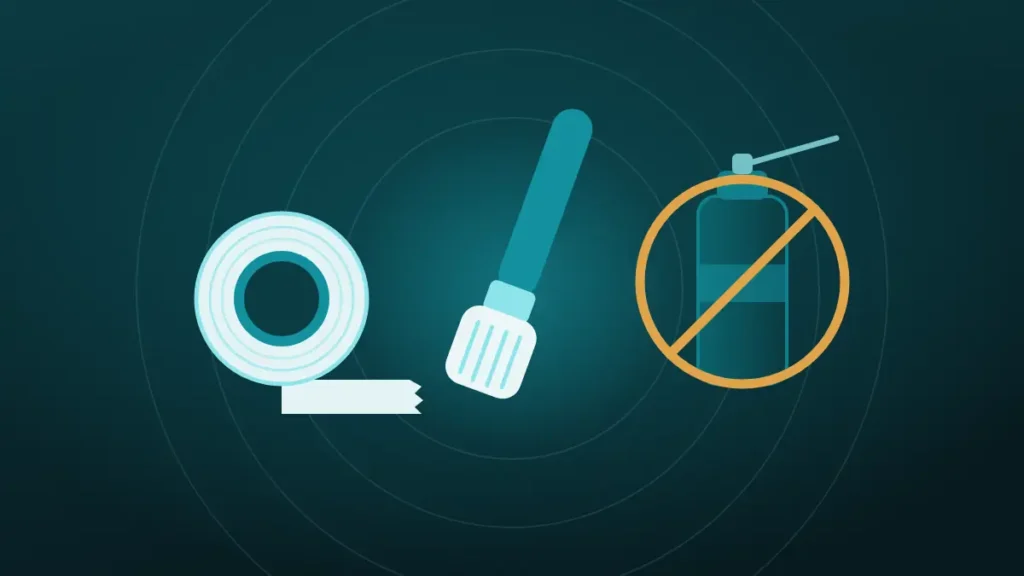
The safest way to clean a phone speaker is a clean, dry, soft-bristled brush, followed by low-tack tape for what the brush loosens. Compressed air is the riskiest of the three, and Apple, Samsung and Google all advise against it.
Three tools come up in every guide, usually presented as equals, with the advice to pick whichever is in the drawer.
They are not equals, because each one applies force to the grille in a different direction, and direction decides whether dirt leaves the speaker or goes deeper into it. That single idea sorts every method, including the ones not in the title.
Clear the speaker now
Volume all the way up, speaker pointing down, phone away from your ear. On iPhone, turn Silent mode off first.
What happened to your speaker?
Hold the phone away from your ear. The tones are loud on purpose.
Turn the volume all the way up and point the speaker down.
More options
The Ranking at a Glance
Here is every common method, ordered from safest to riskiest.
| Method | Moves dirt | Touches the mesh | Adds moisture or residue | Maker stance |
|---|---|---|---|---|
| Soft dry brush | Outward | Lightly | No | Named by Apple and Samsung |
| Low-tack tape | Outward | Lightly | Rarely | Not mentioned |
| Cleaning sound | Outward | No | No | Not mentioned |
| Cleaning putty | Outward | Yes, with pressure | Can leave fragments | Not mentioned |
| Hand blower | Inward | No | No | Not mentioned |
| Vacuum cleaner | Outward, weakly | No | No | Not mentioned |
| Compressed air | Inward, hard | No | Possible liquid spray | Advised against by all three |
| Cotton swab | Inward | Yes | Sheds fibres | Apple warns against it in ports |
| Pin or toothpick | Inward | Punctures it | No | Never recommended |
The top three share one feature. They either lift dirt away from the grille or shake it loose, and none of them pushes.
What Makes a Cleaning Method Safe?
A speaker grille is a row of holes with a fine mesh behind it, and the speaker’s diaphragm sits just beyond that. Dirt collects on the outer face of the mesh. A safe method removes it from that face without disturbing anything further in.
Four questions separate safe from risky:
- Does the force pull dirt out of the grille, or drive it in?
- Does the tool press on the mesh hard enough to dent or tear it?
- Does it bring liquid or leave residue behind?
- Has any phone maker said to use it, or to avoid it?
The first question outweighs the rest. Dirt pushed through the mesh ends up where no home method can reach it, and the speaker stays muffled for good.
Why Is a Soft Brush the Safest Way to Clean a Phone Speaker?
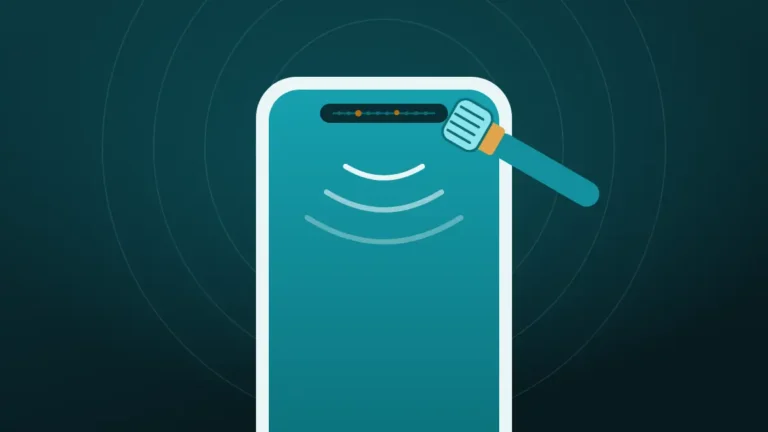
A brush sweeps across the grille instead of into it. The bristle tips catch fibres and flick them sideways and out, and soft bristles bend before they can press on the mesh.
It is also the only tool the makers name. Apple’s speaker troubleshooting page says to clean the opening with a small, soft-bristled brush that is clean and dry. Samsung points to a soft brush as well, used lightly.
The brush is easy to get wrong in three ways.
- A stiff brush scrapes the mesh and pushes fibres into the holes.
- A damp brush turns dust into paste.
- A phone held face up lets the loosened dirt fall straight back in.
An unused soft toothbrush is ideal, and a small clean paintbrush or makeup brush works as well. Hold the phone with the speaker facing the floor, and let gravity finish what the bristles start.
Tape: Good for Surface Lint, With the Right Kind
Tape lifts. Pressed flat on the grille and peeled away, it pulls loose lint straight out, which is the ideal direction.
Its limit is depth. Tape only grips what it touches, so it clears the surface and leaves anything wedged below. That makes it the natural second step after a brush has loosened things.
| Tape | Verdict | Reason |
|---|---|---|
| Painter’s or masking tape | Use | Low tack, peels clean |
| Sticky notes | Use for light dust | Very low tack |
| Clear office tape | Acceptable | Slightly stronger adhesive |
| Packing or duct tape | Avoid | Leaves adhesive on the mesh |
Two habits spoil it. Rolling tape into a point to reach inside a hole turns a lifting tool into a poking one. Pressing hard with a fingernail can also dent the mesh through the tape.
Is Cleaning Putty Safer Than Tape?
Slightly less safe, and sometimes more effective. Putty moulds itself into the holes, so it grips lint that flat tape cannot reach.
The same property is its weakness. Soft putty pressed firmly can tear as it comes away and leave a fragment in a hole, and that fragment is harder to remove than the lint it replaced. Warm, old or cheap putty is the most likely to do it.
Used well, putty is a fair tool. Knead it until it is firm, press it on lightly, and lift it straight off without smearing. On the narrow earpiece slot at the top of the phone, skip it and use tape.
Compressed Air: Why the Makers Say No
Compressed air has the widest gap between its reputation and the official advice. It appears in most cleaning guides, and all three major phone makers advise against it.
| Maker | What it says |
|---|---|
| Apple | Do not use compressed air to clean an iPhone |
| Samsung | Cleaning with an air gun is not recommended |
| Avoid spraying compressed air at the phone |
Apple puts it in its guide to cleaning an iPhone. Samsung’s support site calls an air gun not recommended for speaker holes. Google’s Pixel page tells owners to avoid spraying compressed air at the phone.
The reason is direction again, since a jet of gas aimed at a grille can only push. Lint that was resting on the mesh gets driven through it, and the thin diaphragm behind takes the rest of the blast.
There is a second problem. A can of “air” contains a liquefied gas. Tilt or shake the can and it sprays that liquid, which lands on the phone extremely cold.
People defend it because it works so well on keyboards. A keyboard has open space under the keys for dust to escape into, while a speaker has a sealed chamber, so the dirt has nowhere to go except further in.
Does Holding the Can Further Away Make It Safe?
It makes it weaker, which is not the same as safe. Many guides suggest a distance, and the figures range from an inch to six inches. That spread suggests nobody has measured anything.
Distance reduces the force, and at some point the jet becomes too gentle to hurt the diaphragm. At that same point it is also too gentle to move packed lint. Whatever it does move still travels inward.
No maker publishes a safe distance, because their advice is not to use it at all. A method that only becomes safe when it stops working is not worth keeping.
Hand Blowers and Vacuums
A rubber bulb blower, the kind sold for camera lenses, is far gentler than a can. It puffs ordinary air with no liquid and little force.
It still blows inward. For light, loose dust on the surface, a puff across the grille, not into it, does little harm and a little good. For packed lint, it is not strong enough to matter.
A vacuum cleaner at least pulls in the right direction. In practice a household nozzle cannot seal against holes this small, so the suction at the grille is slight. Holding a large plastic nozzle against a phone also invites knocks and static. It is the right idea in the wrong size.
Where Does Sound Fit In?
Sound is the only method that touches nothing. A tone makes the speaker’s own diaphragm push air out through the mesh from behind, which is the one direction every other tool struggles to reach.
For water, there is evidence. In a test run by iFixit for The Verge, a tone visibly pushed droplets out of phone speakers. For dust, nobody has published an equivalent test, so the claim has to be more modest.
Sound can shake loose particles off the mesh, but it cannot grip a fibre that is wedged in a hole. That makes it a good partner for a brush and a poor replacement for one.
The cleaner at the top of this page plays a 45-second Muffled or dusty cycle for exactly that role.
Things That Should Never Touch a Grille
Some tools fail the direction test so badly that no technique rescues them.
| Tool | What it does |
|---|---|
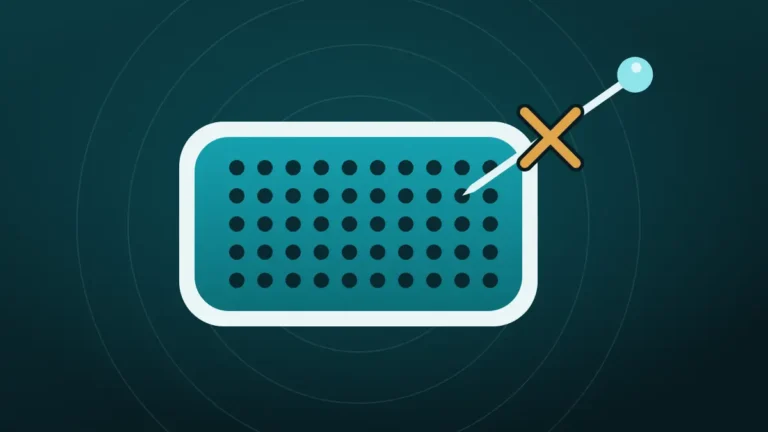
| Pin, needle or SIM tool | Punctures the mesh, and the hole lets everything in afterwards |
| Toothpick | Softer than metal and still harder than the mesh |
| Cotton swab | Pushes dirt in and sheds fibres as it goes |
| Alcohol or water dripped in | Carries dissolved grime through the mesh |
| Blowing by mouth | Adds moisture to dry dust |
The pin is the most tempting, since it fits the holes so neatly. The mesh it damages is the speaker’s only filter. The reasons are set out in why a pin should never go near a speaker grille.
Match the Method to the Dirt
The safest tool still has to suit what is in the grille.
| What is in the grille | Best method | Why |
|---|---|---|
| Loose pocket lint | Soft brush, then tape | Lint lifts easily once disturbed |
| Fine dust | Brush, then a cleaning sound | Sound shakes off what bristles miss |
| Sand or grit | Brush with the speaker facing down | Grains fall out once freed |
| Oily film from skin or makeup | Dry brush first, then a barely damp brush | Oil needs a little solvent, kept off the mesh |
| Water | A water-eject tone and time | Brushing does nothing for a droplet |
| Dried sugary drink | Repair shop | Residue is glued to the mesh |
Wet and dusty together is the awkward case. Let the speaker dry before brushing, because damp lint smears. The method for water is in how to get water out of an iPhone speaker.
Which Order Should You Use Them In?
The safe methods work better together than alone, and the order follows the same logic of loosening first and lifting second.
- Remove the case and hold the phone with the speaker facing the floor.
- Brush across the grille with a soft, dry brush.
- Press flat low-tack tape on the grille and peel it away.
- Run the Muffled or dusty cycle at the top of this page.
- Brush once more and check with a flashlight.
Two or three rounds are reasonable. The step-by-step version, with what to look for, is in how to clean phone speaker dust without opening it.
Nothing on that list costs money, and that suits the job. The best speaker-cleaning kit is a toothbrush nobody has used.
When None of Them Work
Safe methods have a ceiling. They clean the outside of the mesh, and some problems live behind it.
Keep going with brush, tape and sound when:
- Lint or dust is still visible under a flashlight
- The sound improved after the first round
- The speaker went dull gradually over weeks or months
Stop and see a repair shop when:
- The grille looks clean and the speaker is still muffled
- The mesh looks dented, torn or pushed in
- Someone has already used a pin or compressed air on it
- The speaker crackles at low volume
A shop can open the phone and replace the mesh or the speaker, which no outside method can do. If crackling is the main symptom, see crackling phone speaker first.
Reaching for a stronger tool at this point is how blocked speakers become broken ones.
Frequently Asked Questions
What Is the Safest Way to Clean a Phone Speaker?
A clean, dry, soft-bristled brush is the safest tool. Brush across the grille with the speaker facing the floor, then lift loosened lint with low-tack tape. Both move dirt outward, and the brush is the method Apple and Samsung name.
Is Compressed Air Bad for Phone Speakers?
Yes, Apple says not to use compressed air on an iPhone, Samsung advises against air guns, and Google says not to spray it at a Pixel. The jet pushes lint through the mesh toward the speaker, and a tilted can may spray cold liquid.
Can You Use Tape to Clean a Phone Speaker?
Tape works, as long as it is low-tack tape such as painter’s or masking tape. Press it flat on the grille and peel it off to lift surface lint. Avoid packing or duct tape, which can leave adhesive on the mesh.
Is Blu Tack Safe for Phone Speakers?
Mostly, with care. Putty lifts lint well because it moulds into the holes, and the risk is a fragment tearing off and staying behind. Knead it until firm, press lightly and lift it straight off. On narrow earpiece slots, tape is the safer choice.
Can You Use a Toothbrush to Clean a Phone Speaker?
Yes, a soft toothbrush that is dry and has never been used. Brush lightly across the grille using only the bristle tips. Medium and hard brushes are too stiff, and a used brush carries moisture and toothpaste residue.
What Can Damage a Phone Speaker During Cleaning?
Anything that pushes inward or adds liquid can damage it, which rules out pins, toothpicks, compressed air and cotton swabs. Alcohol or water dripped into the grille carries grime through the mesh to the speaker behind.
Can You Use Alcohol to Clean Phone Speakers?
Not directly on the grille. Phone makers allow 70 percent isopropyl wipes on the hard outer surfaces and say to keep moisture out of openings. For oily residue, a brush barely dampened on a wipe is the cautious limit.
Do Speaker Cleaning Sounds Replace Brushing?
No. Sound shakes loose particles free and pushes water out, but it cannot pull a wedged fibre from a hole. Brushing first and playing a cleaning tone afterwards works better than either method does alone.
Conclusion
The safest way to clean a phone speaker comes down to direction. A soft dry brush and low-tack tape move dirt outward, and a cleaning sound helps from behind the mesh. Compressed air, swabs and pins all push inward.
Use the safe three in order, and stop after a few rounds. A speaker that stays muffled with a clean grille needs a repair shop, not a stronger tool.